
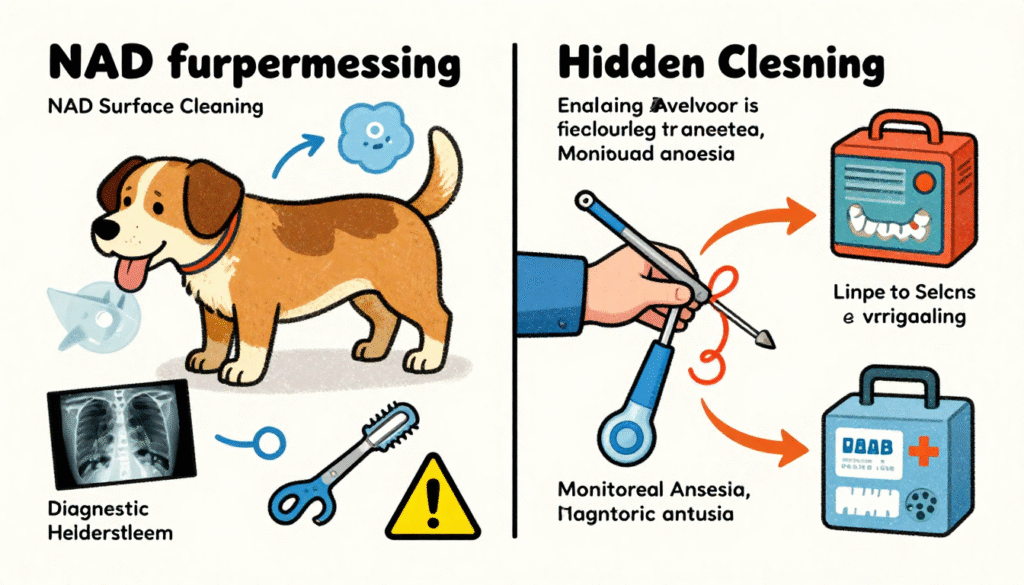
The Seductive Promise: Dental Care Without Anesthesia
Pet owners searching for “safe dental cleaning for dogs without anesthesia risks” are often drawn to mobile services promising sparkling clean teeth without drugs. But when they search “veterinary association position on anesthesia free dental cleaning”, they encounter strong warnings. This balanced analysis examines both sides of this controversial practice.
What NAD (Non-Anesthetic Dental) Cleaning Actually Involves
The Typical NAD Procedure
- Restraint: Manual holding, sometimes with muzzle
- Scaling: Hand tools to remove visible tartar
- Polishing: Optional, with rotary polisher
- Duration: 30-90 minutes depending on cooperation
- Search: “what happens during non-anesthetic dog dental cleaning”
What NAD Providers Claim
- “100% safe” (no anesthesia risks)
- “Stress-free” for pets
- “More affordable” than veterinary cleaning
- “Effective” plaque and tartar removal
- Search: “claims made by anesthesia-free dental services”
The Veterinary Consensus: 7 Major Concerns
1. Incomplete Cleaning: The Illusion of Results
- Visible vs. subgingival: Only crown surfaces cleaned
- Periodontal pockets: Unreachable without probing under gums
- False security: Clean-looking teeth hiding disease below gums
- Search: “subgingival plaque in dogs anesthesia free cleaning limitation”
2. Psychological Stress: The “Stress-Free” Myth
- Physiological measures: Cortisol levels often elevated
- Behavioral signs: Panting, trembling, avoidance behaviors
- Long-term impact: Negative associations with oral handling
- Search: “stress indicators during non-anesthetic dental procedures”
3. Physical Risks: Unrecognized Dangers
- Inhalation of debris: No endotracheal tube protection
- Tooth damage: Inadequate visualization increases fracture risk
- Gum injury: Uncooperative movement during scaling
- Search: “documented injuries from anesthesia free dental cleaning”
4. Missed Diagnoses: The Cost of No X-Rays
- Root abscesses: 40% are invisible without radiographs
- Bone loss: Only detectable with dental X-rays
- Fractured teeth: Often below gum line
- Search: “conditions missed without dental x-rays statistics”
5. Inadequate Pain Management
- Subgingival scaling: Potentially painful without anesthesia
- Existing conditions: May exacerbate pain unknowingly
- No analgesia: Unlike anesthetized procedures
- Search: “pain during non-anesthetic dental scaling studies”
6. Regulatory and Training Issues
- Variable standards: No universal certification requirements
- Equipment sterilization: May not meet veterinary standards
- Emergency preparedness: Limited if complications arise
- Search: “regulation of non-anesthetic dental cleaning services”
7. Ethical Considerations
- Informed consent: Do owners understand limitations?
- Appropriate patient selection: Which dogs are truly suitable?
- Financial transparency: Clear about what’s not being done
- Search: “ethical concerns with anesthesia free dental cleaning”
The Limited Appropriate Use Cases
When NAD Might Be Considered (According to Some Veterinarians)
- Extremely cooperative patients: Rare dogs who genuinely tolerate procedure
- Severe anesthesia risk with no alternatives: Terminal/end-of-life care
- Maintenance between anesthetized cleanings: For mild plaque only
- Search: “appropriate candidates for non-anesthetic cleaning”
Absolute Contraindications
- Periodontal disease: Any pocket depth >3mm
- Oral pain or sensitivity: Indicates likely subgingival issues
- Uncooperative temperament: Stress outweighs benefit
- Known dental problems: Previous extractions, root issues
- Search: “when to avoid anesthesia free dental cleaning”
The Economic Reality: Cost Comparison
Upfront Cost Comparison
| Service | Average Cost | What’s Included | What’s Missing |
|---|---|---|---|
| NAD Cleaning | $150-300 | Supragingival scaling, polishing | X-rays, subgingival cleaning, extractions, pain meds |
| Basic Veterinary Cleaning | $400-600 | Scaling, polishing, exam | Extractions, advanced procedures |
| Comprehensive Veterinary Dental | $800-1500+ | Everything + X-rays, extractions, medications | Nothing (complete care) |
Long-Term Cost Considerations
- NAD repeated frequently: May cost more over time
- Missed problems: Advanced treatment costs later
- Emergency costs: If complications occur during NAD
- Search: “true cost comparison NAD vs veterinary dental”
The Middle Ground: Conscious Sedation Options
Light Sedation Protocols
- Medications: Dexmedetomidine, butorphanol combinations
- Benefits: Reduced stress, maintained airway reflexes
- Limitations: Still can’t do X-rays or subgingival work
- Search: “light sedation for dog dental procedures options”
Multi-Modal Anxiety Reduction
- Pre-visit medication: Gabapentin, trazodone
- Fear-free handling techniques: Low-stress restraint
- Short, frequent sessions: Rather than one long procedure
- Search: “anxiety management for dog dental care without full anesthesia”
Owner Decision Framework: Questions to Ask
Questions for NAD Providers
- “What training/certification do you have?”
- “What happens if my dog becomes stressed or uncooperative?”
- “How do you handle emergencies during the procedure?”
- “What percentage of tartar is subgingival that you can’t reach?”
- “Search”: “questions to ask non-anesthetic dental provider”
Questions for Your Veterinarian
- “Is my dog a candidate for NAD based on their specific mouth?”
- “What are the actual anesthesia risks for my individual dog?”
- “Are there intermediate options between NAD and full anesthesia?”
- “What monitoring will be used during anesthesia?”
- Search: “questions to ask vet about dental anesthesia safety”
The Technology Gap: What NAD Can’t Access
Essential Dental Equipment Requiring Anesthesia
- Dental radiography: 70% of dental disease is below gums
- Periodontal probing: Measures pocket depth, detects disease
- High-speed drills: For proper extractions
- Suction equipment: Prevents debris inhalation
- Search: “equipment limitations of non-anesthetic cleaning”
Breed-Specific Considerations
High-Risk Breeds for NAD
- Brachycephalics: Airway concerns during restraint
- Toy breeds: Often have severe subgingival issues
- Sighthounds: Sensitive to stress, unique anesthesia needs actually safer
- Search: “breeds at highest risk during non-anesthetic cleaning”
Potentially Better Candidates (Still Not Ideal)
- Large, calm breeds: If genuinely cooperative
- Dogs with only mild supragingival plaque: Rare situation
- Search: “which dog personalities might tolerate NAD better”
The Alternative: Comprehensive Anesthesia Safety
Modern Anesthesia Protocols
- Pre-anesthetic testing: Blood work, ECG, blood pressure
- Individualized protocols: Based on breed, age, health status
- Advanced monitoring: ECG, blood pressure, capnography, pulse oximetry
- Search: “modern dog dental anesthesia safety protocols”
Anesthesia Risk Statistics
- Overall mortality: 0.05% for healthy dogs
- With pre-screening: Risk drops to 0.01%
- Compared to NAD risks: No comparative studies exist
- Search: “actual statistics on dog dental anesthesia mortality”
The Compromise Approach: Integrated Care
Combining NAD with Veterinary Care
- Veterinary assessment first: Determine if NAD is appropriate
- Regular veterinary monitoring: Every 6-12 months with X-rays
- Clear understanding: NAD for cosmetic maintenance only
- Search: “integrating non-anesthetic cleaning with veterinary care”
Regulatory and Legal Status
Veterinary Practice Acts
- Most states: Define dentistry as practice of veterinary medicine
- Legal gray area: Some NAD providers operate in loopholes
- Consumer protection: Variable by jurisdiction
- Search: “legality of non-anesthetic dental cleaning by state”
Professional Organization Positions
- AVDC: Strongly opposes (American Veterinary Dental College)
- AAHA: Recommends against (American Animal Hospital Association)
- AVMA: Expresses concerns (American Veterinary Medical Association)
- Search: “veterinary organization positions on NAD cleaning”
The Future: Safer Alternatives in Development
Emerging Technologies
- Better restraint systems: Reduced stress designs
- Improved visualization tools: For supragingival assessment
- Non-invasive diagnostics: Imaging without anesthesia
- Search: “future alternatives to dog dental anesthesia”
The Balanced Verdict: Evidence-Based Position
When NAD May Have a Limited Role
- Cosmetic maintenance: For dogs with excellent home care
- Monitoring tool: Between comprehensive veterinary care
- End-of-life comfort: When anesthesia truly not an option
- Search: “limited appropriate uses of NAD cleaning”
When Veterinary Care is Essential
- First-time patients: Baseline assessment needed
- Any signs of disease: Bad breath, gum redness, etc.
- Breeds prone to dental issues: Most small/toy breeds
- Senior dogs: Higher likelihood of hidden problems
- Search: “when veterinary dental care is non-negotiable”
The Bottom Line for Pet Owners
When searching “is anesthesia free teeth cleaning safe for my dog”, consider:
- Honest assessment: Is your dog truly cooperative or just tolerating?
- Realistic expectations: NAD only addresses what you can see
- Complete information: Understand what’s being missed
- Professional guidance: Consult your veterinarian first
- Risk comparison: Anesthesia risks vs. incomplete care risks
Final Recommendation: For most dogs, comprehensive veterinary dental care under anesthesia, while initially more expensive, provides safer, more effective, and more ethical care. Reserve NAD for very limited, specific situations with full understanding of its limitations.